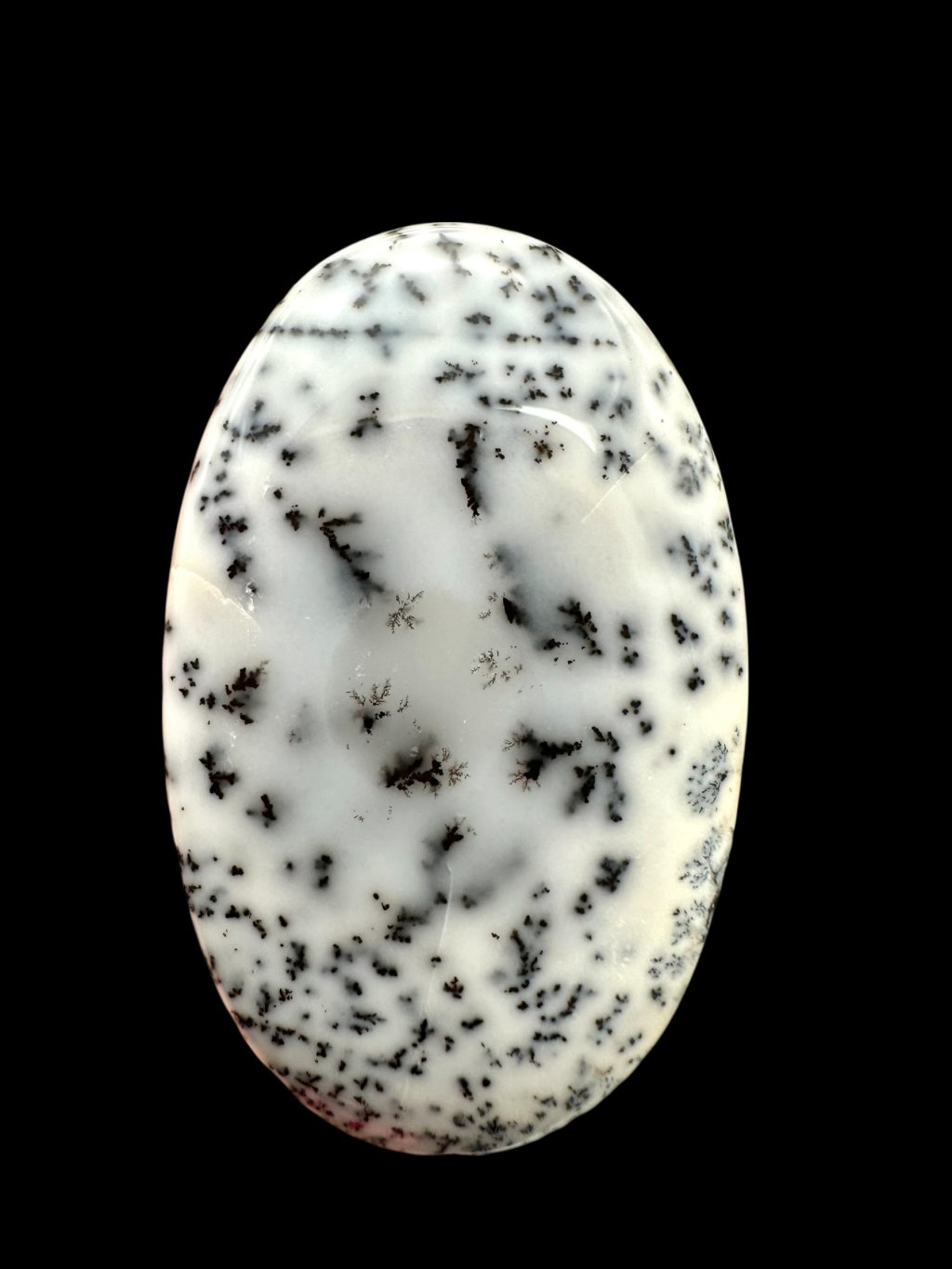
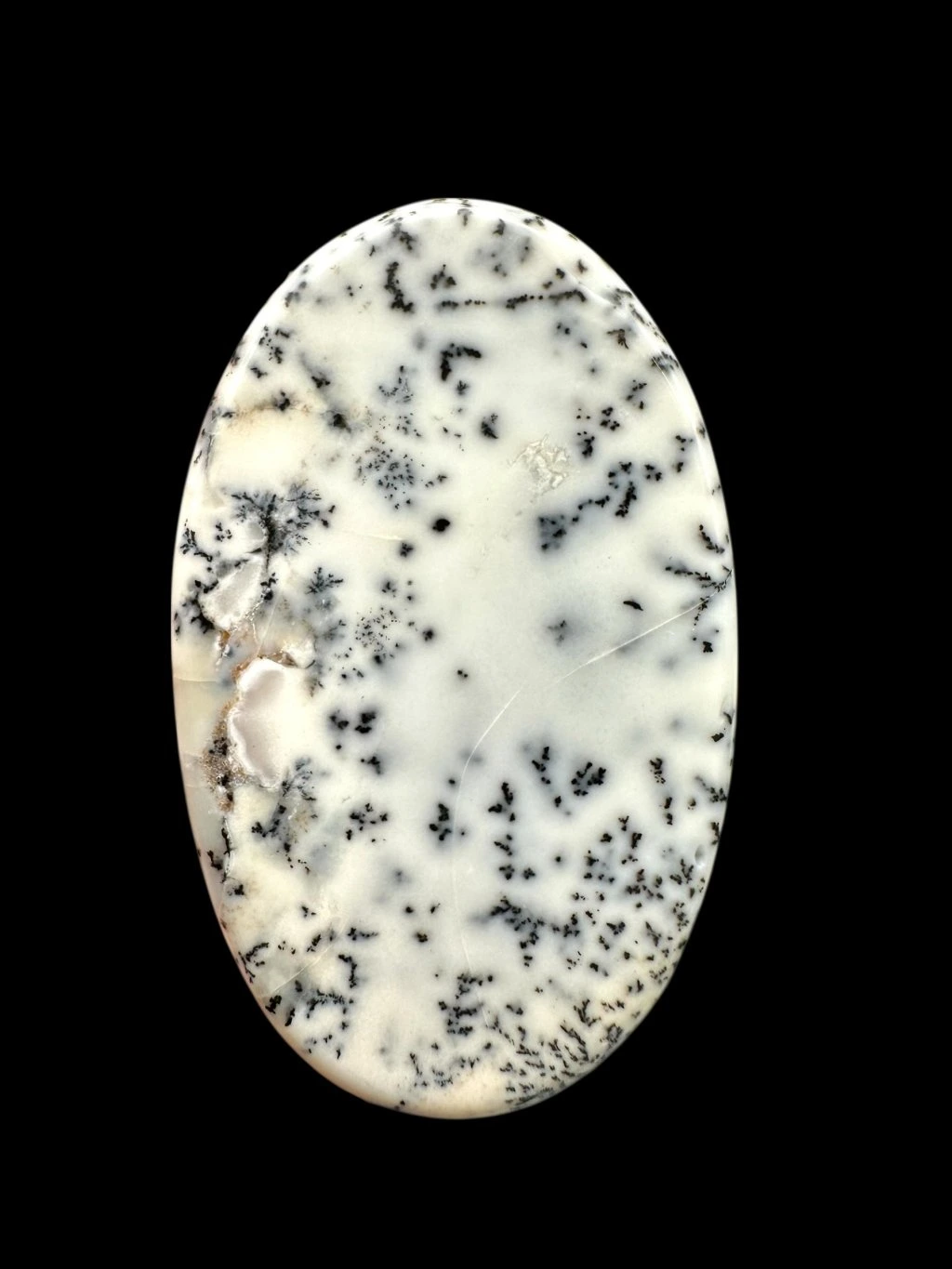
Dendritic opal cabochon – Madagascar
Locality: Madagascar
Weight: 14g
Dimensions: 4,6 x 2,8 x 0,7 cm
| Category: | Dendritic opals |
|---|


Free gift
For order over 50 $

Shipping within 2 working days

Dendritic opal from Madagascar
Dendritic opal is a variety of opal that contains dark branching structures called dendrites. These patterns resemble tree branches, ferns or moss. They are not organic remains but mineral inclusions, most commonly oxides of manganese or iron that entered the opal during its formation.
Unlike precious opal, it usually does not display opalization (play of colors). It therefore belongs to the so-called common opals. They occur in several places around the world. Among the better known localities are Madagascar, Mexico, USA, Kazakhstan and Australia.
Formation
Dendritic opal forms during low-temperature geological processes when water rich in silicon dioxide penetrates cracks and cavities in rocks. As the water gradually evaporates, silica is deposited in the form of opal. At the same time, solutions containing manganese or iron may enter the environment, and their oxides create characteristic branching structures called dendrites. These structures form through the diffusion of mineral solutions and their crystallization in tiny fractures inside the mineral. The result is a unique pattern resembling tree branches, ferns or moss, which is typical of dendritic opal.
Appearance
Dendritic opals have a very characteristic appearance. The base color of the stone is most often white, milky, grey or light cream, while the dendrites are dark brown to black. The branching patterns often spread across the entire surface of the stone and create unique natural designs. Each stone is therefore completely unique, making it a popular material for jewelry and collector stones.
Cabochon
Dendritic opals are very often cut as cabochons. A cabochon is a style of cut in which the stone has a smooth rounded top and a flat base. This type of cut is ideal for minerals with patterns or inclusions because it allows the dendritic structures to stand out clearly. Cabochons made from dendritic opal are mainly used in jewelry. Thanks to the contrast between the light opal and the dark dendrites, these stones appear very decorative.
Hardness and properties
The hardness of opal is approximately 5.5–6.5 on the Mohs scale, which makes it suitable for jewelry, but it must be handled with care. Opal contains water, and is therefore more sensitive to strong temperature changes and drying.