Tourmalines
Tourmalines are among the most diverse groups of minerals and occur in an exceptionally wide range of colors – from black through green and pink to rare blue shades. Well-known tourmalines include, for example, schorl and elbaite, whose color varieties include rubellite, verdelite and indicolite. Our selection includes individual crystals as well as collector specimens from various localities around the world.
✓ Authenticity guarantee ✓ Real product photos ✓ Dispatch within 2 business days ✓ Physical store
#ShowMore#
Types and color varieties of tourmaline
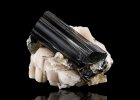
Among the best-known mineral species of the tourmaline group are schorl and elbaite. Schorl is usually black to very dark and is one of the most widespread tourmalines. Elbaite, on the other hand, stands out for its exceptional color diversity and includes a number of well-known color varieties.
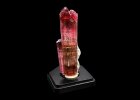
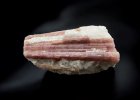
Rubellite refers to pink to red tourmalines, verdelite to green varieties and indicolite to blue shades. Multicolored crystals are also highly attractive, with individual colors changing during the growth of the crystal. A well-known example is the so-called watermelon tourmaline, which typically has a pink center and a green outer zone.
How do tourmalines form?
Many collector-grade and gem-quality tourmalines form in granitic pegmatites. These rocks may be enriched in elements such as lithium, boron or manganese, which influence the formation and coloration of individual tourmalines. Some tourmaline species also occur in metamorphic rocks. Favorable conditions can allow well-developed crystals to form, sometimes reaching considerable sizes.
Important tourmaline localities
Tourmalines are found in many parts of the world. Important sources of collector and gem-quality tourmalines include Brazil, Madagascar, Mozambique, Namibia, Nigeria, Tanzania, Afghanistan, Pakistan and the USA. Individual localities can differ significantly in crystal color, size and form.
Interesting facts about tourmalines
Tourmalines are known not only for their wide range of colors, but also for their pleochroism – when viewed from different directions, a single crystal may show different color intensities or shades. Tourmaline hardness ranges approximately from 7 to 7.5 on the Mohs scale, making some colored varieties suitable for faceting and use in jewelry. Natural crystals are also highly sought after by collectors thanks to their characteristic shape, longitudinal striations and often pronounced color zoning.
Product sorting
List of products


.png?67eda4a9)