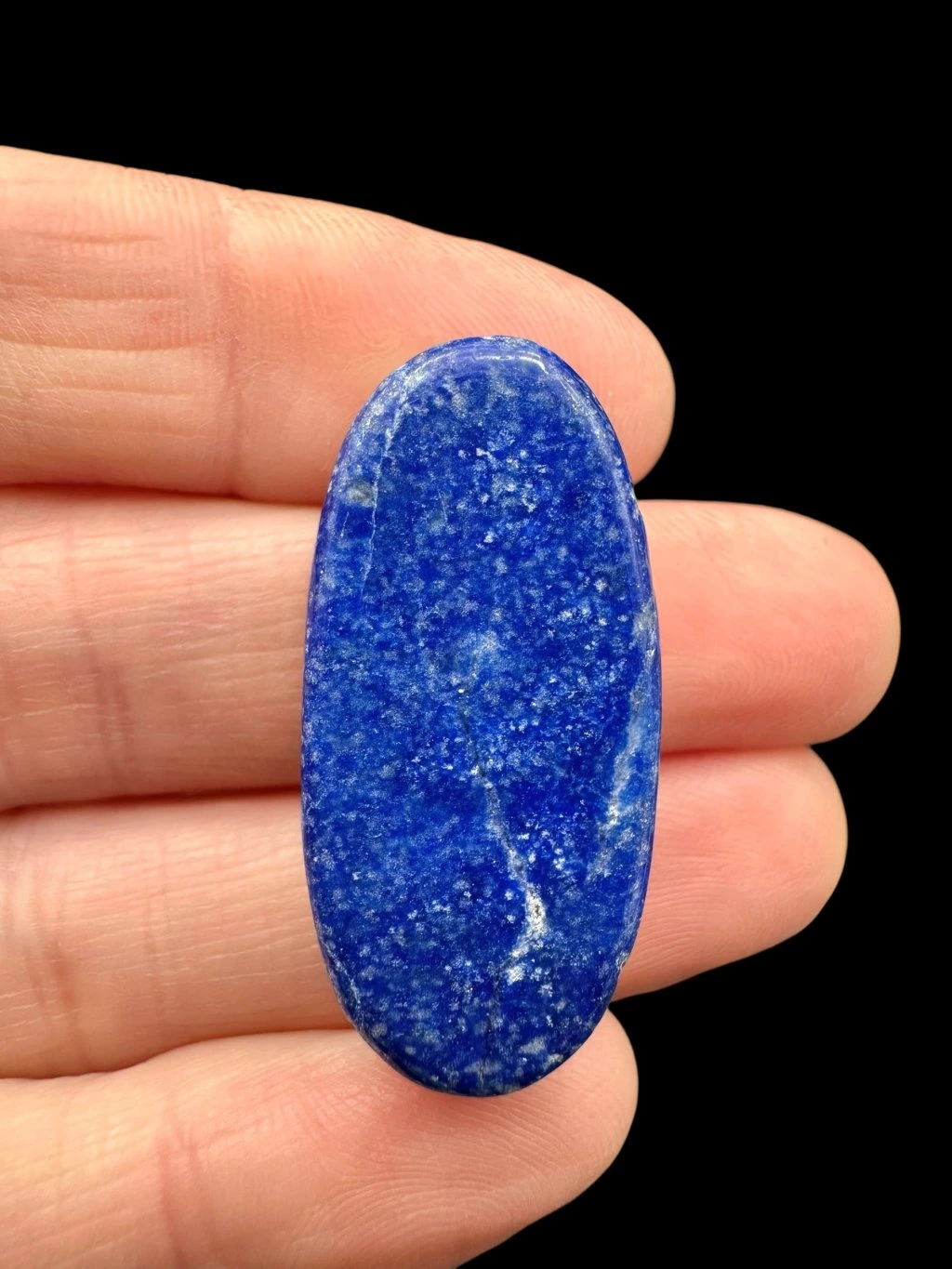
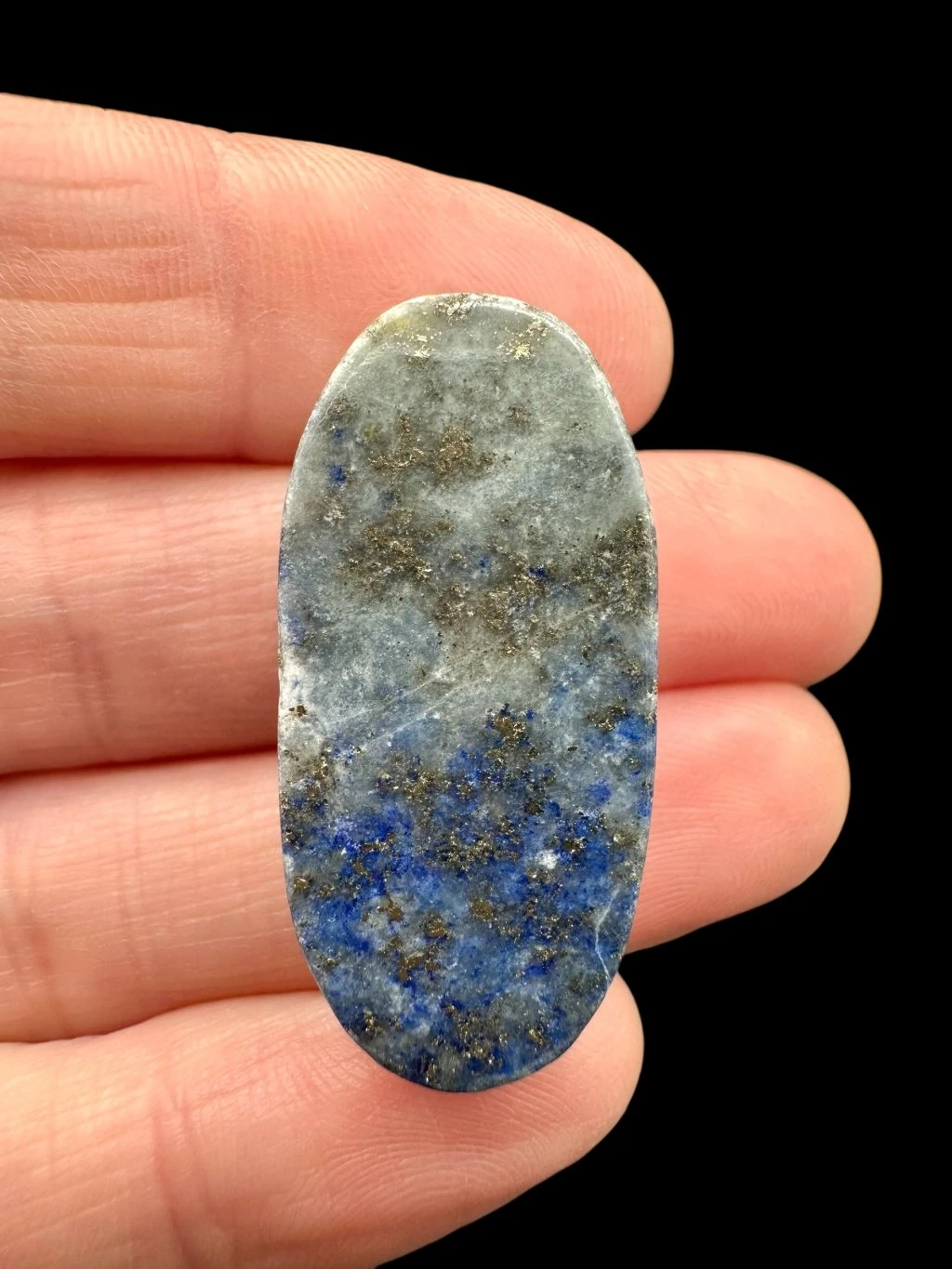
Lapis lazuli cabochon – Afghanistan
Locality: Afghanistan
Weight: 8,6g
Dimensions: 3,2 x 1,5 x 0,7 cm
| Category: | Lapis lazuli |
|---|


Free gift
For order over 50 $

Shipping within 2 working days

Lapis lazuli – a blue stone with a thousand-year history
Lapis lazuli is a well-known deep blue decorative stone that belongs among the oldest materials used for the production of jewelry, amulets and artistic objects. People have been using it since the 7th century BC, when it was valued mainly for its distinctive blue color.
Mineral composition
In fact, it is not a single mineral but a rock composed of several mineral components. The main component is lazurite, which is responsible for the typical intense blue color of the stone. In addition, sodalite is commonly present in lapis lazuli, as well as calcite, which forms white veins or spots, and pyrite, which appears as small golden metallic specks.
Historical significance and the ultramarine pigment
Lapis lazuli was highly valued already in ancient times. It was used, for example, in ancient Egypt, Mesopotamia and Persia. Egyptian pharaohs used it to create jewelry, amulets and ornaments. This stone was also used in funerary masks and decorations, for example in the burial equipment of Pharaoh Tutankhamun.
In the Middle Ages, lapis lazuli became an important source of the blue pigment known as ultramarine. This pigment was extremely expensive and was often even more valuable than gold.
It was used by important Renaissance painters such as Leonardo da Vinci, Michelangelo and Johannes Vermeer, mainly for painting blue parts of clothing and significant motifs in artworks.
Localities
The most famous and highest-quality deposits of lapis lazuli are located in the region of Badakhshan in Afghanistan. Mining here has been taking place for approximately seven thousand years.
Other deposits exist, for example, in Chile, Russia and Pakistan, but Afghan lapis is still considered one of the highest quality in the world.
Hardness and properties
The hardness of lapis lazuli is approximately 5 to 5.5 on the Mohs scale, which means it is relatively soft compared to many other gemstones. Thanks to this it is easy to shape and polish, but it can also be relatively easily scratched.