Pallasites
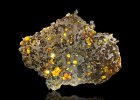
Pallasites are among the most distinctive and well-known stony-iron meteorites. They are typically composed of a combination of iron-nickel metal and olivine crystals, which are often clearly visible in cut and polished specimens. Olivine may display yellow, golden, green to brownish shades and can be translucent in high-quality pieces.
Our selection includes natural pallasites as well as cut and polished specimens from various localities around the world. Each meteorite differs in the amount of metal, size and color of the olivine crystals, internal structure and state of preservation.
✓ Authenticity guarantee ✓ Free E-Certificate with meteorites ✓ Real photos of the offered specimens ✓ IMCA member ✓ Physical store
#ShowMore#
What Is a Pallasite?
A pallasite is a type of meteorite composed of a mixture of metallic and silicate components. The metallic part consists mainly of iron-nickel alloys, while the silicate component is usually represented by crystals of olivine. It is this combination of bright metal and colored olivine grains that gives pallasites their characteristic appearance.
Pallasites belong to the group of stony-iron meteorites. Their structure formed during complex processes within differentiated asteroids, where metallic and silicate materials had originally separated. However, the exact formation mechanism of the individual pallasite groups is not necessarily the same and remains a subject of scientific research.
Olivine in Pallasites
The most striking component of most pallasites is the olivine crystals embedded in an iron-nickel matrix. Olivine is a group of silicate minerals and may occur in pallasites as individual grains or larger crystals of various shapes.
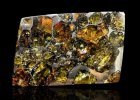
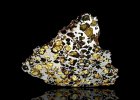
After the meteorite is cut and polished, some olivine crystals may transmit light very well. Their colors range from pale yellow through golden and olive green to darker brownish shades. The appearance varies considerably between individual meteorites and even between different slices of the same meteorite.
Natural and Cut Pallasites
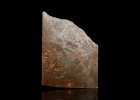
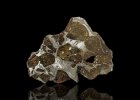
Natural pallasites preserve the original exterior of the meteorite. Depending on the degree of weathering, they may have a dark, rusty-brown or irregularly textured outer surface, and the olivine may not always be clearly visible.
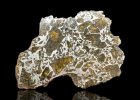
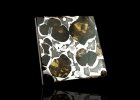
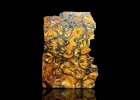
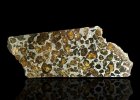
Cut and polished pallasites, on the other hand, reveal their internal structure. The distribution, size, color and translucency of the olivine crystals within the metallic matrix can be clearly observed on the cut surface. In some pallasites, the metallic component may also display Widmanstätten patterns after professional etching.
Well-Known Pallasites from Around the World
Individual pallasites differ in locality, chemical composition, structure and the appearance of their olivine. Our selection includes, for example, Sericho from Kenya, Seymchan from Russia, Brahin from Belarus, Imilac from Chile, Esquel from Argentina and Springwater from Canada.
How Are Pallasites Classified?
Pallasites are not a single homogeneous group. The majority of known specimens belong to the Main Group Pallasites. In addition, there are several smaller groups and ungrouped pallasites that differ in the chemical composition of the metal, the composition of the olivine and other mineralogical properties.
How to Choose a Pallasite?
If you prefer to preserve the natural character of the meteorite, a natural specimen is a suitable choice. For observing olivine crystals and internal structure, cut and polished pieces are more suitable. When choosing, you can consider the locality, size and color of the olivine, the ratio of metallic to silicate material, crystal translucency, state of preservation and type of processing.
Pallasites contain a significant amount of iron-nickel metal and may be sensitive to moisture. We therefore recommend storing them in a dry environment and avoiding unnecessary contact with polished surfaces with bare hands.







Product sorting
List of products


.png?67eda4a9)